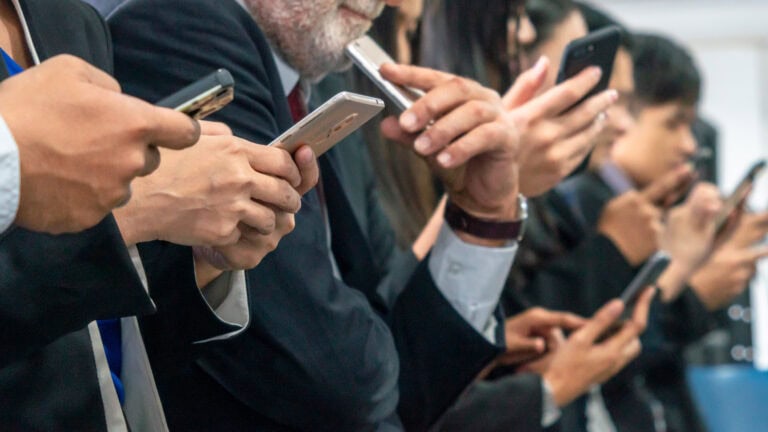
Recently, I had to run some lunch-time errands in the Central District of Hong Kong. If you know Hong Kong, you know that from noon to 2 pm, swarms of office workers descend to the walkways to quickly fill their bellies and return to their desks. What startled me on this day was the number of adults glued to their smartphones while walking to their destinations amongst this thick crowd. I started counting people and estimated how many were looking at their phones versus their surroundings. My very non-scientific estimate was that 20% were glued to their phones — 1 in 5 people.
We openly talk about the effect that too much screentime has on our children’s developing brains, including poorer academic performance, reduced attention spans, weaker social skills due to less face-to-face interactions, sleep disturbances due to excessive blue light, and increased risk of mental health issues, including anxiety, depression and low self-esteem. Physically, it can contribute to obesity from sedentary behaviour, eye strain and headaches.
But what about us, the adults? I’ll admit that I spend well over the recommended limit of three hours of screen time a day on my iPhone. I’m addicted, and you probably are too. Why is this an increasing phenomenon amongst adults? What is the cost of this addiction, and what can we do to change this?
Why is smartphone addiction increasing amongst adults?
Adults are getting increasingly hooked on phones because apps are designed to grab attention with endless notifications and dopamine hits from likes or new content. Big tech companies use persuasive design techniques, also known as dopamine-driven design, to keep users engaged and addicted to apps for profit. These techniques, rooted in behavioural psychology, include intermittent rewards like likes and notifications, infinite scrolling, and personalised algorithms that create a “scarcity loop” of unpredictable content, making it hard to disengage. The goal is to maximise user time on the platform to increase ad views and revenue.
Work is also a factor, as many jobs demand constant connectivity, blurring lines between off and on hours. Social pressure doesn’t help; everyone’s glued to their screen, so it feels normal. Plus, phones are an easy escape from stress or boredom, and with algorithms feeding tailored content, it’s tough to look away. Data backs this — studies show average daily screen time for adults is climbing, with some hitting seven hours or more.
What is the impact of increased screen time on adults?
Same as with adolescents, increased screen time can mess with adults’ mental health in a few ways. It’s linked to higher anxiety and depression, especially when folks compare themselves to curated lives on social media. Too much scrolling disrupts sleep as blue light from screens throws off your body’s rhythm, leaving you tired and moody. It can also ramp up stress, as constant notifications keep you on edge. On the flip side, some find online communities supportive, but the data’s clear: heavy use, like over three hours daily, often correlates with poorer mental well-being, per recent studies.
We also see the impact of smartphone addiction on relationships, when partners lessen face-to-face communication in favour of scrolling. And how do we model healthy behaviour for our children when they see us constantly glued to our phones? We don’t.
Is that Blue Light issue real? Do you have research to back this up?
Yes, there’s solid research on blue light’s impact. Studies, like those from the National Institute of Health, show blue light from screens suppresses melatonin, the hormone that helps you sleep, which can mess with your circadian rhythm. A 2019 study in Chronobiology International found that even short exposure before bed delays sleep onset and reduces sleep quality. Harvard researchers have also linked blue light to increased alertness at night, which sounds cool but screws up rest. The evidence is pretty consistent — blue light’s no friend to your sleep cycle.
Why is this important? Counsellors and psychologists know that sleep is the foundation of mental health, and poor sleep quality contributes to depression, anxiety, overall mood and physical functioning.
Okay, you got me, I’ll admit I’m addicted. What do I do now?
Do you want to step away from the screen a bit? You can set specific no-screen hours, like during meals or before bed. Try swapping screen time for a hobby, like reading a physical book or going for a walk. Use apps that lock you out after a set time — ironic, but they work. Keep your phone out of arm’s reach, maybe in another room. And plan face-to-face hangouts with friends to stay connected without the glow.
Look at the root cause of the addiction. Why are you seeking the dopamine hit? Is there something lacking in other parts of your life? How is scrolling actually making you feel? Do you notice if you feel more anxious after looking at the Apps? If so, that’s a sign that the behaviour isn’t healthy. Is it affecting your mood or self-esteem? And what would make you feel better and help you move towards the actual life you really want, not the fantasy Instagram life?
If you’d like to discuss these questions further and map out a plan to overcome the addiction to move towards healthy behaviours, real joy and life meaning, please contact us. As always, we are here to help. Let’s tackle this together!